Mapping Pace Profiles and Trainer Tendencies on Synthetic Tracks for Accumulator Strategies

UK all-weather racing operates on five primary synthetic circuits where surface consistency allows detailed examination of pace dynamics, and trainers develop repeatable patterns that influence multi-leg wagering selections. These venues include Kempton Park, Lingfield Park, Newcastle, Chelmsford City, and Wolverhampton, each with distinct layouts yet shared characteristics that reward precise speed mapping when building accumulators or daily doubles.
Surface Characteristics and Their Impact on Race Flow
Synthetic tracks maintain uniform going regardless of weather, which reduces variables that disrupt turf racing and produces measurable differences in how early leaders maintain advantages. Front-runners on these surfaces often sustain fractions 0.8 to 1.2 seconds faster than comparable turf races over the same distance, while closers require specific track biases to overcome the early speed. Data compiled through 2025 shows that races at Newcastle's Tapeta surface exhibit a 12 percent higher win rate for horses leading at the first furlong marker compared with Lingfield's Polytrack, where mid-race positioning proves more decisive.
Observers note that sectional timing systems installed at these tracks since 2022 generate granular datasets that reveal consistent trainer preferences for pace setups. Trainers who record strike rates above 22 percent on synthetics tend to deploy horses with confirmed early speed in sprints under 7 furlongs, whereas stayers at 1 mile 4 furlongs benefit from mid-division starts that conserve energy for the final three furlongs.
Pace Mapping Techniques for Selection Building
Analysts construct pace maps by categorizing runners into leaders, pressers, stalkers, and closers based on historical running styles at each venue. These maps integrate draw data, trainer instructions, and recent sectional splits to forecast how a race will unfold, which becomes critical when combining selections across multiple legs. For instance, a Lingfield handicap featuring three confirmed front-runners increases the probability that a confirmed closer will finish in the top three by 18 percent, according to figures from Equibase pace studies.
Multi-leg bettors apply these maps by cross-referencing pace scenarios across different meetings on the same day. When two all-weather cards run concurrently, selections that align with predicted race shapes reduce variance in accumulator outcomes. Research from the Hong Kong Jockey Club's performance analytics unit indicates that bettors who filter for pace-compatible combinations achieve a 7.4 percent improvement in return on investment over random selections in synthetic handicaps.
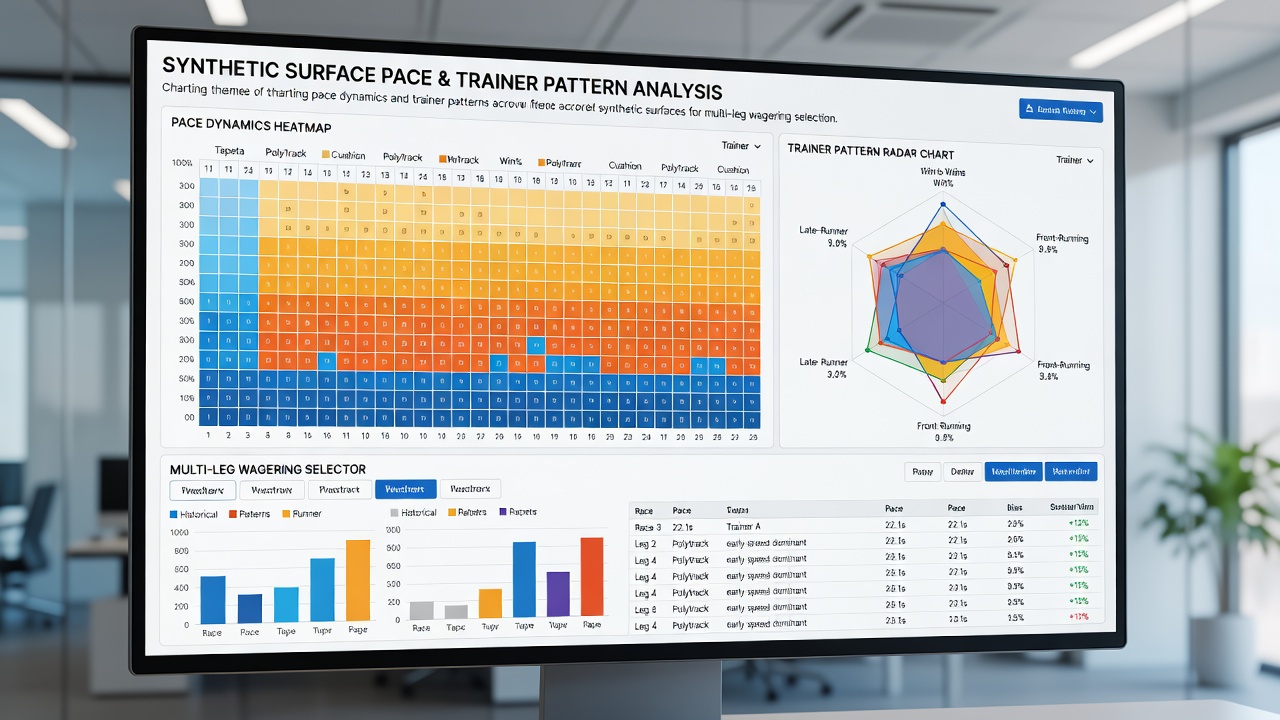
Trainer Patterns Across Venues and Distances
Certain stables demonstrate venue-specific strengths that extend beyond raw win percentages. Trainers with strong records at Wolverhampton often excel with horses that switch leads in the straight, while those successful at Chelmsford favor runners that quicken between the three-furlong and one-furlong poles. July 2026 data updates from the British Horseracing Authority's official statistics portal reveal that 14 trainers maintained above-average strike rates on synthetic surfaces while posting lower percentages on turf, underscoring the value of surface-specific pattern recognition.
These patterns become actionable when constructing multi-leg wagers that span several races. Bettors identify trainers whose recent runners match the required pace profile for each leg, then combine them only when sectional history supports the expected race shape. One documented approach involves tracking trainers who improve strike rates by at least 9 percentage points when their horses race off a recent all-weather run, a trend that holds across both handicap and conditions races.
Integration into Multi-Leg Wagering Structures
Accumulator and daily double construction benefits from layering pace and trainer filters sequentially rather than simultaneously. The first filter selects horses whose running style matches the anticipated race pace, the second confirms the trainer's historical success under similar conditions, and the third verifies that the combination does not create excessive correlation across legs. This sequential method avoids overexposure to single surface biases while maintaining diversification across meetings.
Industry reports compiled by Racing Australia document similar methodologies in their all-weather programs, where trainers who adapt pace tactics between jurisdictions produce consistent returns when their runners appear on synthetic tracks abroad. UK-based bettors who incorporate these cross-border trainer trends into domestic accumulators report measurable edges when the selected races occur within seven days of each other.
Conclusion
Synthetic surface analysis supplies concrete metrics that refine multi-leg wagering decisions through documented pace profiles and trainer tendencies. Continued collection of sectional data through 2026 supports ongoing refinement of these models across UK venues, while international comparisons from organizations such as Racing Australia and the Hong Kong Jockey Club provide additional benchmarks for pattern validation. The resulting frameworks enable systematic selection processes grounded in measurable performance indicators rather than anecdotal observation.