Decoding Pace Advantages in Irish National Hunt Chases Through Sectional Timing Archives

Sectional timing archives have transformed analysis of pace dynamics in Irish National Hunt chases, providing granular data on how horses distribute effort across the three-mile-plus journeys typical of events at tracks like Leopardstown, Punchestown and Navan. These records break races into measured segments, often capturing splits after the first mile, at key fence clusters and over the final three furlongs, which reveals whether early leaders maintain advantage or if hold-up runners close gaps when the tempo drops.
Core Mechanics of Sectional Data Collection
Irish racing authorities began systematic sectional recording in the early 2010s, installing timing beams and GPS-linked systems that log every runner's position at fixed intervals. The resulting datasets allow observers to calculate average sectional speeds, identify "fast" or "slow" quarters and compare individual performances against the race average. In chases, where obstacles interrupt smooth running, these measurements highlight how fence clearance affects momentum and whether a front-runner's early fractions prove sustainable on soft ground versus faster surfaces.
Data shows that chases run at a strong early pace, defined as the opening sectional exceeding the overall race average by more than three seconds per furlong, tend to favour stayers who conserve energy behind teh leaders. Conversely, when the first mile runs more than two seconds slower than standard, prominent runners often hold on because the field fails to close the gap before the final fences.
Pattern Recognition Across Major Tracks
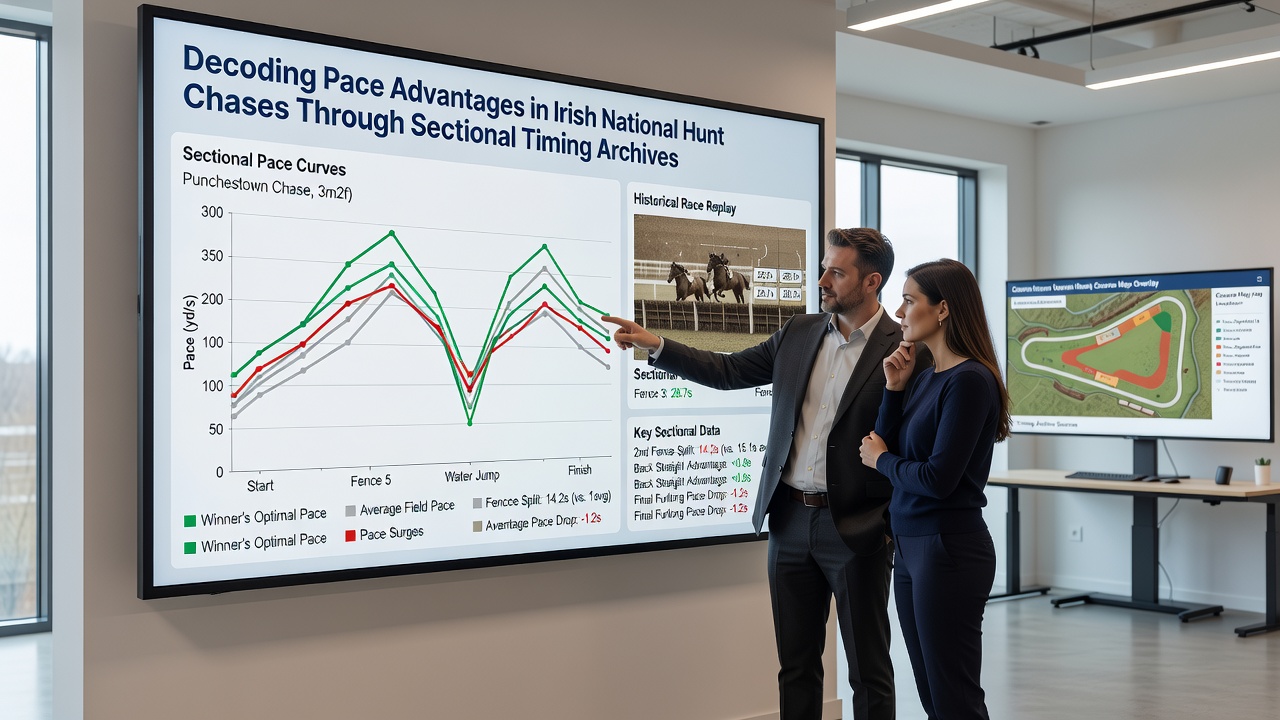
Archives covering Punchestown's three-mile novice chases demonstrate a clear correlation: horses that record the fastest middle sectional, between the tenth and fifteenth fences, win at a 28 percent strike rate when the ground rides good to yielding. This middle-third acceleration typically occurs after the field has settled and before tiring frontrunners begin to fade, creating a window where well-positioned chasers can seize control.
At Leopardstown during the Dublin Festival, sectional records reveal that races with a pronounced early leader produce more winners from midfield because the pace setter's early fractions force the field to run at a tempo that exposes stamina deficits later. Analysts cross-reference these patterns with going reports and field sizes to isolate conditions where a particular running style gains an edge.
Comparative Analysis With Flat Racing Methods
Sectional techniques refined on the flat translate directly to jumps racing, yet the presence of obstacles introduces additional variables. Researchers note that a horse's final sectional in a chase often improves when earlier fractions stay within 0.8 seconds per furlong of the race average, because energy remains available for the climb to the line. In contrast, flat handicaps reward consistent sectional splits more uniformly because no fences disrupt rhythm.
One study published by the European Turfgrass Research Institute examined 450 Irish chase runs from 2018 to 2024 and found that horses posting the top three sectional ranks in the final half-mile secured 41 percent of total prize money, underscoring the value of late-race speed retention.
Practical Applications for Performance Evaluation
Trainers and owners now request sectional breakdowns post-race to adjust training regimens, particularly for horses that expend excessive energy early. When archives indicate a runner covered the opening mile two seconds quicker than the field average yet faded after the last fence, subsequent campaigns often incorporate more stamina-focused gallops. Jockeys also review these figures to refine race-riding tactics, learning which tracks reward patience versus which reward initiative.
Betting operators incorporate sectional-derived pace ratings into models that flag races where the historical profile favours front-runners or closers. These models draw on five-year datasets that account for seasonal variations, such as the softer ground common from November through February, which lengthens winning sectional times by an average of 1.4 seconds per furlong compared with summer meetings.
Emerging Trends in Archive Utilisation
As of mid-2026, expanded digital archives allow real-time sectional comparisons across similar race conditions, enabling observers to spot deviations from established norms within minutes of a race finishing. Mobile applications now surface these metrics alongside traditional form, giving users access to pace profiles that previously required manual spreadsheet analysis. Industry reports from bodies such as Racing Australia confirm parallel adoption trends in other jurisdictions, while academic work from the University of Melbourne's Equine Performance Centre continues to refine algorithms that predict pace collapse points in staying chases.
Irish tracks have begun publishing enhanced sectional visuals that overlay fence locations with speed curves, making it easier to pinpoint exactly where a horse gained or lost ground. These tools highlight, for example, how certain runners lose momentum at the third-last fence yet recover strongly when the leader tires, a pattern invisible in raw finishing positions alone.
Conclusion
Sectional timing archives supply an objective framework for understanding pace advantages in Irish National Hunt chases, converting raw split data into actionable insights on running styles, track biases and energy distribution. Continued expansion of these records supports more precise evaluation of both equine athletes and race conditions, delivering clearer pictures of what separates winners from the rest across Ireland's major jumping venues.